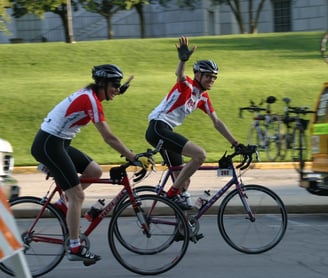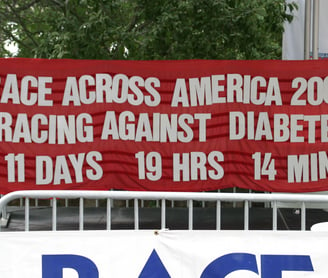
|
|
Racing
Against
Diabetes
Foundation, Inc. |
DIABETES AND
EXERCISE
|
|
|
|
Racing
Against Diabetes |
|
|
|
|
_____________ Join us and Race
against Diabetes! (free
T-shirts!) (Donations
help buy more T‑shirts, but you don’t have to donate, just promise to train .
. . !) |
IMPORTANCE OF EXERCISE
Words from Diabetes
Support Crew Chief/Coach/Teammate Dr. Patty Riddle, M.S. (physical
education), Ph.D. (health education): First, click here for
the Centers for Disease Control’s summary of its study on the terrifying risk
of diabetes (1 in 3 for American males born in 2000, 2 in 5 for females, and
even higher rates for people of African-American or Hispanic-American
heritage). Click here for CDC’s
summary of the Diabetes Prevention Program (establishing that a healthy diet
and moderate physical activity results in dramatic reduction in risk of
diabetes). And click here for
CDC’s “Diabetes Fact Sheet 2005,” with good general information about
diabetes and some awful statistics, including the number of amputations on
diabetics (82,000/year!), cases of blindness (12-24,000 new cases/year!),
etc. Also, note that CDC reports that
nearly two-thirds of adults in the United States are
overweight, and 30 percent are obese.
The importance of exercise and
weight loss is beyond any question, for preventing complications of diabetes,
and also for preventing and even reversing Type 2 (the prevalent kind—95% of
diabetics are Type 2’s). Click here for
the National Institutes for Health (NIH) website on, among other things, the
importance of exercise in preventing or delaying onset of Type 2
diabetes. The American Diabetes
Association (ADA) doesn’t emphasize exercise enough, but click
here for its basics on exercise.
Also, Diabetes Exercise and Sport Association (DESA) has some
interesting stuff for hard-core athletes at http://www.diabetes-exercise.org. You’ll have to become a member to get most
of their materials, however. Patty’s Cost/Benefit
Analysis for Diabetes and Exercise: (Huh?! —OK, we
confess: Terry wrote all of this.) ·
Benefits—More is Less . . . 1.
More exercise provides less risk of complications,
especially heart disease and foot problems. 2.
More exercise allows less medications—you’ll take
smaller doses of diabetes medications. 3.
More exercise provides less of risk of having
diabetes at all. (See the Diabetes
Prevention Program results at the link cited above.) —A friend at work was diagnosed as
pre-diabetic, and after exercising and losing weight has completely normal
blood sugars! ·
Benefits—More is More, too . . . 1.
More exercise allows you to eat more. Terry’s favorite story is of attending a
diabetes education class years ago.
In the second week, the group members reported every gram of food they
ate each day the previous week. Terry
filled two sides of the page for each day because he was exercising so
much—and the rest of the group hated him!
But by the end of the class, everyone had become a regular
exerciser! (Terry’s still
gloating over that success!) 2.
More exercise also gives you more energy. Try it! 3.
More exercise will give you (more) new friends,
too. ·
Costs of Extreme Exercise—More is More and
Less, more or less . . . 1.
With the amount of exercise Terry gets (namely, more),
he has to test his blood sugar more times than anyone likes—usually 10 times
a day. He checked it 20-30 times a
day during the RAAM last year. 2.
More exercise than any sane person (not
Terry) needs may result in less stable blood sugars—not high averages
(HbA1c’s), but lots of low blood sugars, in Terry’s case. He says it’s worth it. And his cardiac surgeon says everyone in
the operating room was jealous of Terry’s coronary arteries when he had his
valve job two years ago. Patty’s
Recommendations—whether you have diabetes or not: ·
Buy a heart rate monitor. You’ll be surprised how fun and motivating
it is. Learn how to use it, or e-mail
us. ·
Exercise at least moderately, at least 30 minutes
a day, five days a week. Learn about
training levels and watch your heart rate monitor—keep your heart rate in the
zone for your training plan. Talk to
your doctor. ·
On second thought, for anyone with diabetes, get
some exercise every day. Walking is
great. Biking is great. Anything’s great. ·
Set up a regular schedule for when you’ll
exercise. Exercise with a teammate if
possible—a schedule with a teammate will make it much easier to get out and
do it, and keep doing it. ·
Ramp up your training gradually. Don’t go out and do it all at once
today. Cycling is great for training
to beat diabetes because it’s low-impact on your joints. Cycling is actually very good for your
knees--but you need to increase miles and effort gradually, and keep up your
cadence (spinning the pedals) so you don’t overstress your knees before
they’re ready to climb mountains. ·
A training program does also include a nutrition
plan. –About six months before each
of his Tour de France victories, Lance Armstrong weighed everything he ate to
make sure he was following his plan—and he’s not diabetic! --In Terry’s case, he thinks of food as
just fuel so he won’t think it’s “the enemy.” He really doesn’t much care about how it tastes, as long as
it’s healthy. ·
Drink lots of water. And make sure you eat at least five fruits and veggies a
day—and I don’t mean catsup! (But
skip the brussel sprouts, Terry says.)
For more nutrition info, see the American Dietetics Association’s
website at www.eatright.org,
or click
here for American Diabetes Association’s website. ·
If you can think of food as fuel, and try to
balance your fuel intake with your fuel needs, you’ll be doing far better
than almost everyone in the U.S. But
Terry’s a bit weird, of course—and it took a lot of years of having diabetes
before he got to that point. But the
important points are that it’s good not to eat a lot of junk food, it’s good
to be aware of the glycemic index of foods (—how fast some “starches” raise
blood sugars will startle you), and it’s good to put less food on your
plate—because you’ll eat less that way without effort. ·
It’s important to lose weight by exercise and
portion control if you’re overweight—whether you’re diabetic or not. If you’re not diabetic, it’ll reduce your
chances of getting it, and if you’re diabetic you’ll reduce risk of
complications, reduce medications—and, potentially, reverse your diabetes. ·
Get the kids off the video games and on bikes—by
riding with them. It’ll be good for
you and the kids. It’s terrifying
that diabetes is becoming so prevalent that one out of every three babies
born today in the U.S. will end up with diabetes. Unlucky genes are unlucky genes, but we can reverse the trend
of increasing diabetes by getting exercise and eating reasonably. ·
Terry’s
Two-Cents-Worth: ·
Bikes are ideal for exercise for all of us—with or
without diabetes—because almost everyone can ride a bike. Stationary bikes count, too, after
all. You can watch TV or read the
newspaper or a book while you’re on a stationary bike—but get that heart rate
monitor so you can watch it and make sure you’re getting some exercise (and
not too much, either). If you buy a
new stationary bike, I recommend getting a highly adjustable one (like the
bikes in Spinning classes), and getting it set up right so it’ll be good for
your knees. Then set up your saddle high enough. ·
If your bike isn’t stationary, you must wear a
helmet. Period. ·
Buy some real honest-to-goodness bike shorts with
a pad inside. (Buy mountain-bike
shorts if you’re embarrassed by Lycra.
But why be embarrassed? We’re
all in this together.) ·
Bikes are great for social time. –Get together riding instead of
eating. Get out and see folks! And meet new friends—everyone on a bike
will say Hi! or wave. ·
When you get on a bike, you’ll be amazed you
forgot how much you like to ride. ·
E-mail me if you don’t know how to buy a bike, or
to find a bike club or a riding group if you’re interested. When you buy a bike, go to a real bike
shop so you’ll get fitted properly. ·
About that eating thing: food really is just fuel.
But that took me 30 or so years of diabetes to get comfortable with
that notion. One really effective way
to lose weight is to write down everything you eat—that’s painful in one
respect, but really simple in another.
Another way is to just reduce fat intake: in the Diabetes Prevention Program study, pre-diabetics lost
5-7% of their weight (and reduced their risk of getting diabetes by 58%) just
by exercising moderately and restricting their fat intake to 25% of their
total calories. —You really can learn
to like fat-free milk, and you really don’t need dressing on your salad or
butter on your bread. Trust me. I haven’t put butter on anything in years,
and I’m not lacking in happiness! ·
I very much appreciate that I’m so healthy because
of luck (along with great doctors and lots of exercise). Anyone else with 40 years of diabetes and
the same blood sugars and even the same amount of exercise might have had a
lot of complications by now. But
regular exercise helps all of us diabetics keep our feet, our kidneys, our
sight . . . —and helps our support crews and friends from getting
diabetes. Let’s all get out and ride
together! |
|